The Binario Bulletin | February 2026 Edition

The Salesforce Moment

Why a Platform Built for Scale Is Suddenly Everywhere in Behavioral Health

In recent months, we explored how documentation evolved from a compliance requirement into a clinical standard. Through the ASAM series, one truth became clear: modern behavioral health no longer runs on intuition alone. It runs on structure, continuity, and systems that can carry institutional memory forward.
Read all Previous Newsletters Here

In recent months, we explored how documentation evolved from a compliance requirement into a clinical standard. Through the ASAM series, one truth became clear: modern behavioral health no longer runs on intuition alone. It runs on structure, continuity, and systems that can carry institutional memory forward.
Read all Previous Newsletters Here

As the calendar turns, a different conversation is surfacing, quieter, less clinical, but just as consequential. It centers around a name that keeps appearing in meetings, vendor discussions, and operational planning sessions.
Salesforce.

A Name That Keeps Coming Up

These days, the name “Salesforce” shows up in passing comments. In offhand remarks during leadership meetings. In conversations that begin with, “We’ve been hearing a lot about this Salesforce thing lately…
 
For many in behavioral health, it’s still unfamiliar territory. Not because it’s new, but because it wasn’t built for this industry originally. And yet, increasingly, it’s being discussed as though it belongs here. 
Not loudly. Not urgently. But persistently.

What Salesforce Actually Is

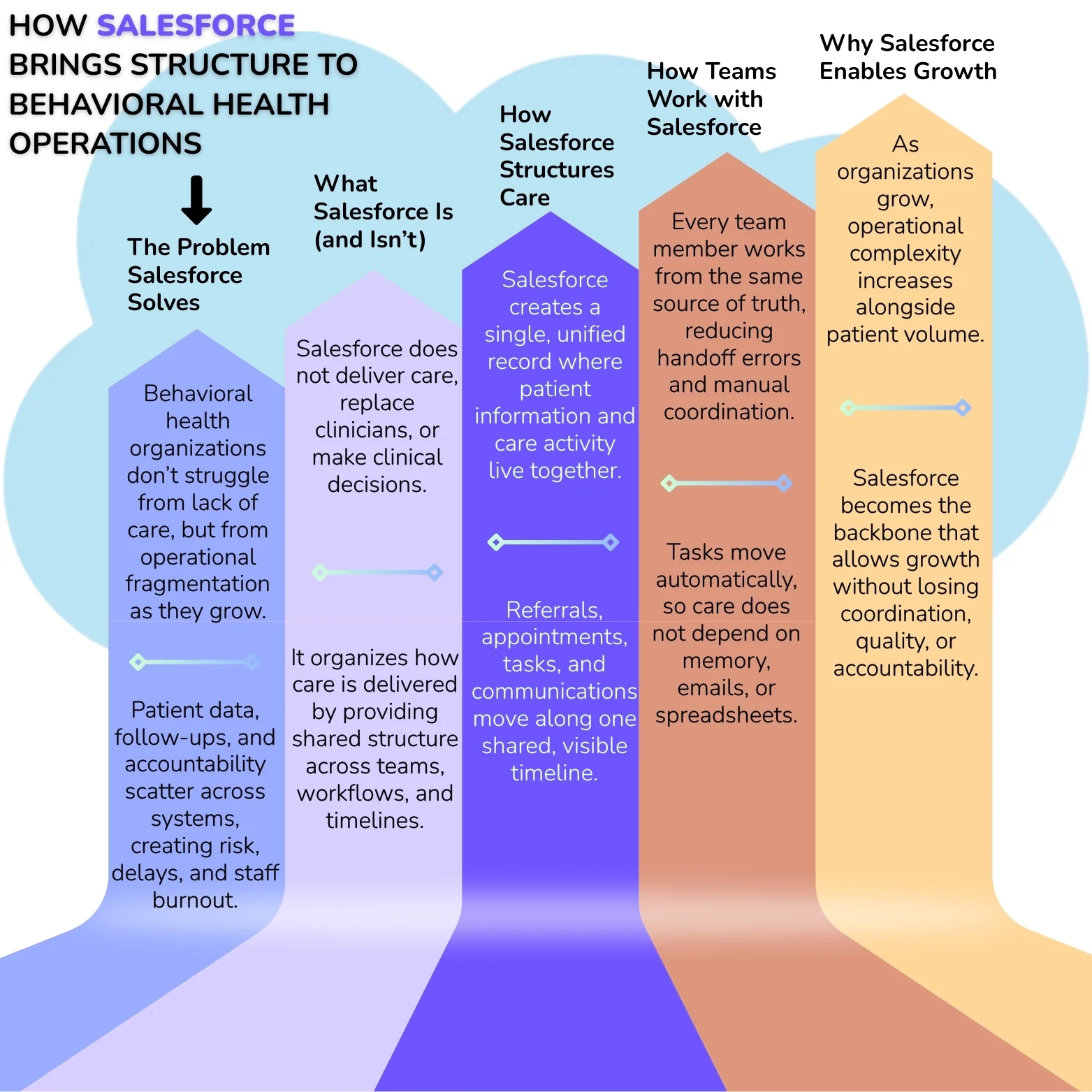
At its core, Salesforce is not a system that delivers care.
It is a system that organizes how care is delivered.
And….
It does not treat patients.
It does not replace clinicians.
It does not make clinical decisions.

For behavioral and mental health teams, this means every patient has a single, unified record. Every referral, appointment, follow-up, and communication is tracked. Every team member sees the same timeline. Tasks move automatically instead of being chased manually.

As organizations grow, Salesforce becomes the operational backbone that keeps teams aligned, patients engaged, and processes consistent. Allowing facilities to scale services without losing coordination, quality, or accountability. 

In fast-growing industries, Salesforce became the spine that enabled growth without chaos.

Behavioral health has now reached that same moment, where growth at scale and stability must exist together.

Why Behavioral Health, and Why Now!

Behavioral health didn’t arrive at this Salesforce moment by accident.
Let’s see how behavioral health reached a breaking point due to lack of structure to support growth and scaling at large.
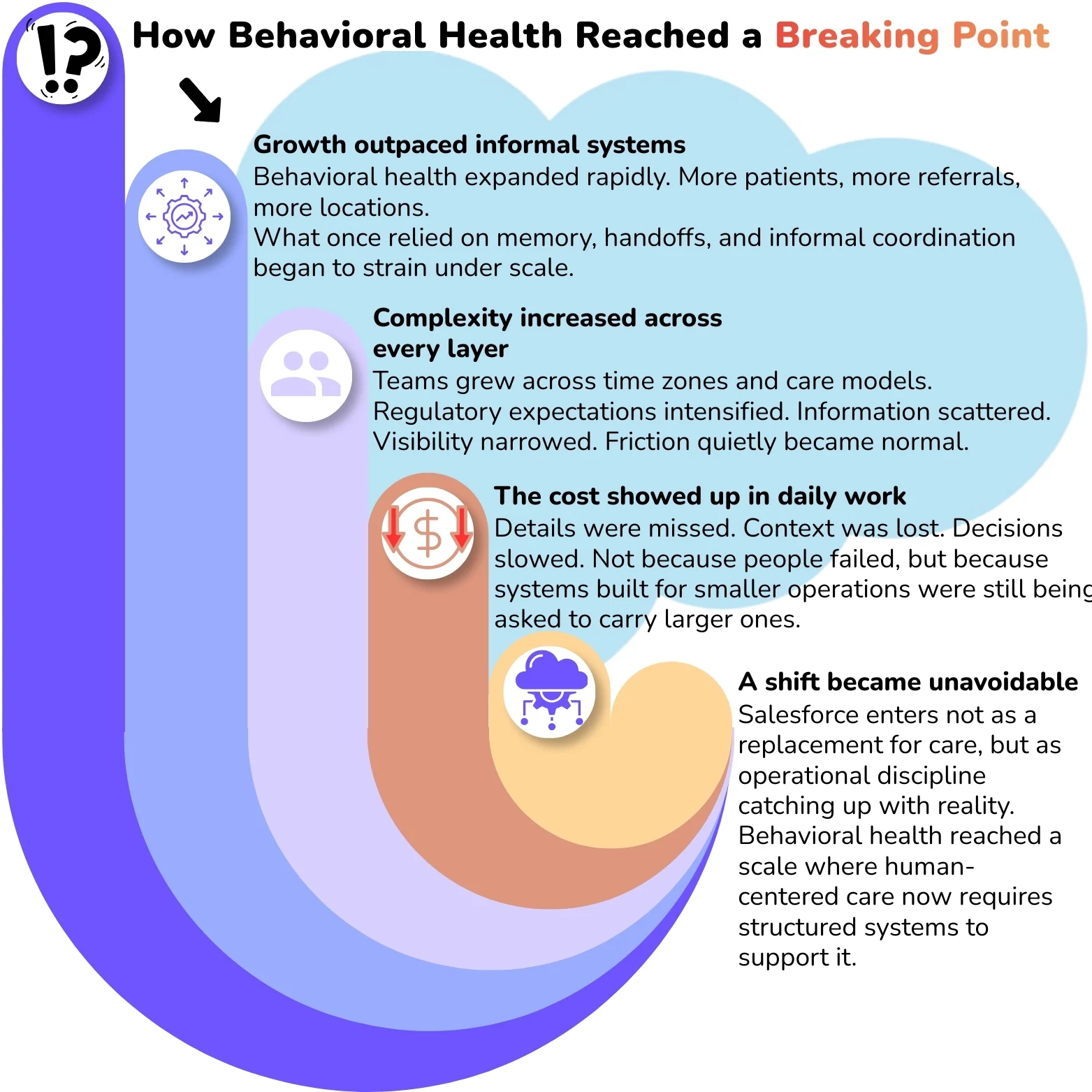
The timing matters. Behavioral health now requires the same operational discipline long expected in other high-stakes industries, without losing the human core that defines care.
 
This is why Salesforce is appearing in the conversation now. Not as a trend, but as a response to accumulated pressure.

Beneath the Buzz: What Leaders Are Really Trying to Solve

Behind the conversations about platforms and tools sits a more human concern: 
How do we keep track of everything without exhausting the people doing the work?
 
Behavioral health leaders are not chasing technology. They are chasing continuity, the ability to see what’s happening, understand what’s next, and respond before problems escalate. 
 
Salesforce becomes relevant only because it promises something familiar: fewer dropped balls, fewer surprises, fewer moments where someone asks, “Did anyone follow up on that?” 

The Quiet Shift Already Underway

The most notable part of this shift is how understated it is.
  • No dramatic overhauls.
  • No sudden transformations.
Instead, small changes. Centralized views. Shared information. Fewer side spreadsheets. Less reliance on verbal handoffs.
When systems begin carrying memory, teams regain bandwidth. When information becomes visible, urgency softens into planning.
This is the phase behavioral health is entering now, whether intentionally or not.  

The Question January Leaves Behind

Salesforce may be the name everyone is hearing, but it isn’t the story.

The real question is what comes next.
If Salesforce is the structure, what fills it? If it’s the backbone, what connects to it? And how does it serve the daily realities of care, not just operations?

That is the conversation unfolding next.
Latest News in Behavioral Health Space

  • Mental Health | Childhood Stress Impacts Health From Womb Through Adolescence New research from UCSF shows how stress impacts children’s mental and physical health from prenatal stages through adolescence, reinforcing the importance of early prevention and family-centered interventions.  -University of California, San Francisco, 2026-
  • Mental Health Care Funding Returns After Policy Whiplash Funding for key mental health and substance use disorder programs was briefly cut by the Substance Abuse and Mental Health Services Administration (SAMHSA) before being swiftly restored due to bipartisan pushback. The episode underscores volatility in federal support for behavioral health services and potential impacts on access to care..  -American Psychological Association-
  • Call to Action | AMA Outlines Strategy on Substance Use Disorder Treatment The American Medical Association published a call for decisive action on substance use disorder treatment and overdose prevention, noting the urgent need for stronger care systems as tens of thousands of lives continue to be lost annually.  -American Medical Association, 2026-

The Binario Bulletin — February 2026

Voice of the Clinicians

“Not sure if this counts, but I’ve started letting patients pick a song for our last 5 minutes of session. Weirdly, it’s become the highlight of the day for some, and honestly, it keeps me smiling too.”
– Mental Health Specialist, Community Behavioral Health Center, Westcoast –
Every clinician has a story, a quick win, a clever fix, or a “why didn’t we do this sooner?” moment worth sharing.
This new corner of the Bulletin is where your insights, tips and little sparks of wisdom take center stage. Think of it as a friendly exchange between minds who get what the work really feels like.
And who knows, next month, it might be your words lighting up this space.
💡
Just hit reply to this email to submit yours. Please include your name, position, and organization. 
 You might get featured in next month’s Voice of the Clinicians!

Subscribe Now

Join thousands of professionals who trust Binario Research for the latest healthcare and automation insights. Stay ahead with our weekly newsletter.

Begin Your 60-Day Trial Today